A Small Business Marketing Plan That Works | Cap Puckhaber
How I Build a Small Business Marketing Plan That Actually Grows Revenue
By Cap Puckhaber, Reno, Nevada
I've spent years building marketing plans for small businesses, including my own. Most owners I meet feel buried before they even begin. They hear about SEO, paid ads, influencers, and AI tools, then they freeze. So I pulled my introductory advice into one foundational guide. It covers the marketing plan, the buyer persona, the budget, and the channels that earn their keep.
Nothing here is theory. Every framework in this post came from campaigns I've run and paid for with real money. Some of them worked beautifully, and one of them cost me 4,000 dollars before I caught my error. I'll show you that mistake too, because the lesson was worth more than the loss. My goal is simple, and it's to make marketing your most reliable growth tool instead of your biggest headache.
What Marketing Really Means for a Small Business
Marketing used to be a one way broadcast. A shop bought a print ad or a radio spot, then hoped the message stuck. Modern marketing works as a two way conversation between your business and your customers. It covers everything you do to attract people, earn their trust, and keep them coming back. Four pieces matter most when you're starting out.
Market Research Comes First
Research is the foundation under everything else. It means gathering real information about your customers, competitors, and industry before you spend a dollar. Because so many owners skip this step, so much marketing money gets wasted. I once surveyed twenty customers for a local coffee roaster and learned their buyers cared more about delivery speed than price. That single insight reshaped the whole campaign and lifted repeat orders by 18 percent in one quarter. Guessing is expensive, while asking is nearly free.
Branding Gives Your Business a Personality
Your brand is more than a logo. It's the voice, the values, and the feeling people get when they deal with you. A strong brand separates you from every competitor selling something similar. Since buyers have endless choices, that feeling often decides who gets the sale. Write down three words you want customers to use when describing you. Then check whether your website, packaging, and emails actually express those words.
Content Builds Trust Before the Sale
Content is the value you give away for free. Blog posts, short videos, and helpful social updates all teach your audience something useful. Each piece earns a little more trust, and trust turns a stranger into a buyer. But don't publish just to publish. One genuinely helpful article beats ten thin ones every single time.
Advertising Buys the Reach You Can't Earn Yet
Paid promotion guarantees your message lands in front of a specific audience. It ranges from Google and Facebook ads to a local radio spot or an event sponsorship. Ads work fastest when the research and branding came first. Without that groundwork, you're paying to show strangers a message they won't remember.
Why Email Earns the Biggest Share of My Budget
Email marketing means sending personalized messages to people who asked to hear from you. Those messages can carry promotions, newsletters, product updates, or a simple thank you. I lean on email harder than any other channel, and the data backs me up. Research from Litmus pegs the average email marketing ROI at 36 dollars for every dollar spent. No other digital channel comes close to that figure.
The Numbers Tell the Story
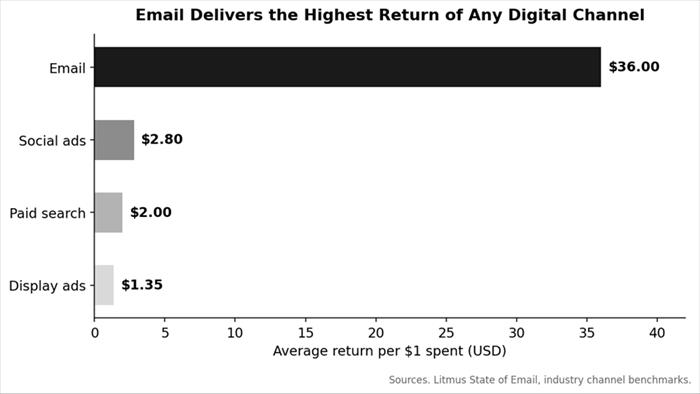
Average return per dollar spent across major digital channels. Email leads by a wide margin.
Paid search returns about two dollars for every dollar invested. Social advertising lands near 2.80 dollars, while display ads trail at 1.35 dollars. Email returns 36 dollars on the same investment. Since the gap is that wide, I treat email as the retention engine for every client I serve. The chart above explains why I refuse to treat it as an afterthought.
How I Run a Simple Email Program
My process hasn't changed much in years because it keeps working. I collect addresses through a signup form and one strong lead magnet, usually a short checklist. Then I load the list into a platform, write a three part welcome sequence, and segment people by what they click. Every send gets reviewed a week later for opens, clicks, and sales. When a retail client followed this exact setup, her open rate climbed from 14 percent to 31 percent in two months. Her email revenue tripled over the same stretch.
What I Actually Send Each Month
A new subscriber gets three welcome emails over ten days. The first delivers the lead magnet, the second tells the brand story, and the third makes a soft offer. After that, everyone receives one useful newsletter per month and one promotion at most. Twice a year I send a win back note to anyone silent for six months. That single win back email recovers roughly 5 percent of a sleeping list, which is nearly free revenue.
Picking a Platform Without Overthinking It
Mailchimp suits most beginners because the free tier covers your first several hundred contacts. Constant Contact offers friendlier support if you want a human on the phone. ConvertKit fits creators, while GetResponse and AWeber both handle automation well. Honestly, the platform matters far less than the consistency of your sending. Pick one, commit for six months, and judge it on revenue rather than features.
Reputation Work Happens Before You Need It
Public relations means managing how the public sees your brand, often through earned media mentions. Customer service is the quieter half of the same job. Both build the credibility that makes every other channel cheaper. A glowing review pile lowers your ad costs because more clicks convert. So ask every happy customer for a review within 48 hours of the sale, while the goodwill is fresh. I've watched that one habit double a client's monthly review count in a single quarter.
Bad reviews deserve a reply too, and the reply is really for future readers. Stay calm, own anything you got wrong, and offer to make it right offline. Future customers judge you on the recovery far more than on the original complaint. One restaurant client turned a two star review into a regular customer with a single gracious response. Her reply also showed hundreds of profile visitors exactly how she treats people.
Building a Marketing Plan That Holds Up
A marketing plan is your roadmap. It gives you direction, helps you defend a budget, and keeps everyone pulling the same way. Mine always starts with two research steps before any tactic gets discussed. Skipping them is the most expensive shortcut in small business marketing.
Start With One Detailed Buyer Persona
You can't sell to a customer you haven't defined. A buyer persona combines demographic data, meaning the who, with psychographic data, meaning the why, and behavioral data, meaning the how. Pull the raw material from Google Analytics, a short survey, and three real customer conversations. Communities like r/smallbusiness on Reddit are a goldmine too, since owners and buyers describe their pain points there in their own words. I reread relevant threads every month and borrow the exact phrases people use. Those phrases become subject lines and ad headlines that convert.
What a Finished Persona Looks Like
Here's a real example from a landscaping client. Their best customer was a homeowner aged 38 to 55 with household income above 120,000 dollars. She valued reliability over price and dreaded chasing contractors who never called back. Her research happened on Google Maps reviews and neighborhood Facebook groups, almost never on Instagram. Once we knew that, we stopped posting reels and started answering every review within a day. Leads from their business profile rose 42 percent in ninety days.
Run a Quick SWOT Before You Spend
A SWOT analysis organizes what your research uncovered into four boxes. Strengths and weaknesses are internal, so list what you do well and where you're exposed. Opportunities and threats live outside your walls, like a competitor closing or a new rival opening nearby. Fill in three honest entries per box and patterns appear fast. One client realized her only serious weakness was relying on a single channel for 90 percent of her leads. We fixed that months before it could become an emergency.
Setting Goals With the Goal Pyramid
I organize goals in a hierarchy I call the Goal Pyramid. Each level supports the one above it, so nothing floats without a purpose. The structure keeps a team honest when shiny new tactics show up midyear. It also makes reporting painless because every metric ladders up to revenue.
The Business Objective Sits on Top
The top level holds one big company goal grounded in your reality. If you grew 15 percent last year, a stretch target of 20 percent is ambitious but sane. A concrete example would be reaching 500,000 dollars in annual revenue. Write it somewhere you'll see it weekly. Everything below exists to serve that single number.
Marketing Goals Fill the Middle
The middle level translates the business objective into marketing outcomes. To reach that revenue number, you might need 1,000 new customers this year. Maybe you also need to lift average order value by 10 percent. Keep this level to two or three goals at most. Since focus beats volume, fewer goals get more done.
Channel Goals and KPIs Form the Base
The bottom level gets tactical and specific. An example would be 500 qualified leads from Google Ads in the third quarter at a cost per lead of 40 dollars or less. Every goal at every level should be SMART, meaning specific, measurable, attainable, relevant, and time bound. Vague goals produce vague effort. Hard numbers force decisions, and decisions move revenue.
How Much Should You Actually Spend
Guidance from the U.S. Small Business Administration suggests that companies under five million dollars in revenue put 7 to 8 percent of gross revenue toward marketing. Newer businesses usually need more, often 12 to 20 percent, because awareness starts at zero. Established companies defending market share can sometimes hold the line at 3 to 5 percent. I set the budget at the start of every year and revisit it each quarter.
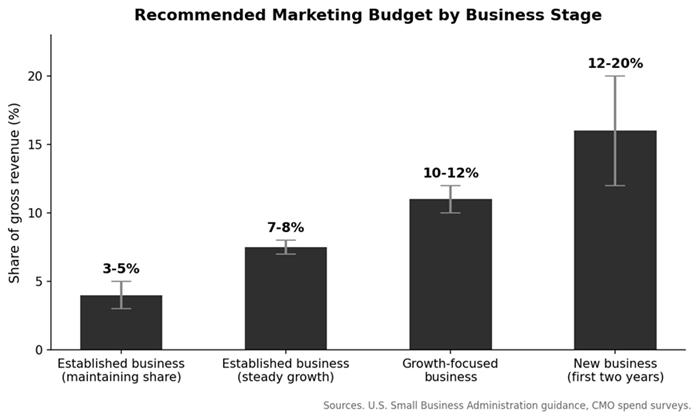
Recommended marketing spend as a share of gross revenue, by business stage.
The ranges above are starting points rather than laws. A business running thin margins can't spend like one running fat margins. So calculate your customer acquisition cost early, then let that number tune the budget. If you spend 10,000 dollars and gain 50 customers, each one cost you 200 dollars. Compare that figure against what a customer is worth over time, and the right budget reveals itself.
How I Split a Typical Budget
For a typical client around 600,000 dollars in revenue, the budget lands near 45,000 dollars. Roughly 40 percent goes to paid search and social ads. About 25 percent funds content and SEO work. Another 15 percent covers email tools, software, and design. The remaining 20 percent stays loose for testing new channels. Because that testing reserve exists, we never raid a working channel just to chase a shiny idea.
Choosing Your First Two Channels
Don't try to be everywhere at once. I ask new clients to pick two channels and ignore the rest for six months. The right pair depends on how your customers buy and how fast you need results. Here's the comparison I walk through with every owner.
| Channel | Best For | Primary Goal | Speed to Results |
| SEO and Content | Businesses customers actively search for, like plumbers, lawyers, and software | Long-term asset and quality leads | Slow, 6 to 12 months |
| Paid Ads | E-commerce and urgent lead generation | Immediate sales and fast testing | Fast, days |
| Social Media | Visual brands and community builders | Awareness and engagement | Medium, 1 to 3 months |
| Nearly every business | Retention and the highest ROI | Fast, immediate |
Match the Channel to How Customers Buy
SEO and content suit businesses people actively search for, like plumbers, lawyers, and software companies. The payoff is slow, often six to twelve months, but the asset compounds for years. Paid ads deliver leads within days, which makes them right for e-commerce and urgent lead generation. Social media builds awareness for visual brands over one to three months. Email serves nearly everyone because keeping a customer costs less than finding one. While no single mix fits every business, audience behavior should always cast the deciding vote.
Claim Your Google Business Profile First
Before any of that, claim and complete your free Google Business Profile. Local buyers increasingly ask their phones questions like who fixes AC units near me. A complete profile with photos, hours, and fresh reviews answers those spoken searches. Update your FAQ page with natural, question shaped language for the same reason. This costs nothing except an afternoon, and it outperforms paid channels for many local businesses.
The 4,000 Dollar Mistake I Won't Repeat
Early on I launched Google Ads for my own services without checking search intent. The keyword looked perfect on paper, but the people typing it wanted free templates rather than paid help. I spent 4,000 dollars over six weeks and booked exactly one consultation. Worse, I had no negative keyword list, so irrelevant clicks drained the budget daily. Don't run a single paid campaign until you've studied the live search results for your exact keyword. That ten minute check would have saved my whole budget.
The fix turned out to be boring and cheap. I rebuilt the campaign around three buyer intent keywords, added forty negative keywords, and cut the daily budget in half. The same offer then produced eleven consultations over the following six weeks. Failure taught the lesson, but a written process kept the tuition from doubling.
Where AI Fits Without Taking Over
AI tools now handle the repetitive work that used to eat my afternoons. SurferSEO analyzes the top ranking pages for a keyword, then hands you a target word count and a term list. Zapier connects new form submissions to your email platform and your team chat automatically, which saves me about four hours weekly. Jasper drafts a serviceable intro when writer's block strikes at the worst moment. But strategy still has to come from a human who knows the customer. I treat these tools like a sharp intern, fast and useful, never unsupervised.
Paid Social, Done the Targeted Way
Paid social advertising differs from posting on your page. You pay the platform to put your message in front of a precise audience. That precision is what makes a small budget efficient. A local yoga studio can show ads only to women aged 25 to 45 within ten miles who follow wellness topics. Not one dollar gets wasted on people who would never walk through the door.
Pick the Platform Where Your Buyers Already Are
Facebook and Instagram fit consumer brands, local businesses, and visual products. LinkedIn rules business to business work because you can target by job title and company size. Pinterest works for home, hobby, and fashion products since users arrive already planning purchases. TikTok reaches younger buyers who reward authentic, unpolished video. Choose one platform and learn it deeply before you add a second.
My Three Step Ad Setup
First comes the objective, whether awareness, traffic, or conversions. The platform tunes delivery around whichever goal you select, so choose honestly. Next come the audience and the budget, built straight from your buyer persona research. I cap daily spend on every new campaign until the data proves the offer. Last comes the creative, meaning one strong image or video, a headline aimed at a real pain point, and a clear call to action.
Micro Influencers Beat My Best Ad Campaign
The smartest influencer money now goes to creators with 10,000 to 100,000 followers. Their audiences are smaller but far more engaged and trusting. A boutique clothing client of mine partnered with a local fashion blogger on a single reel. That one video generated more sales than any paid campaign the store had ever run. Find creators through Collabstr or by searching hashtags tied to your city.
Track every partnership with a unique discount code, something like SARAH15, or a UTM tagged link. Attribution turns influencer work from a gamble into a measurable channel. Reach out with a personal note about a specific post you genuinely enjoyed. Generic pitches get ignored, and deservedly so. Pay fairly, measure honestly, and the good creators will keep working with you.
A Week Inside My Actual Routine
People assume good marketing demands forty hours a week. Mine takes closer to six for a typical small client. Monday gets one hour for reviewing last week's numbers across email, ads, and search. Tuesday gets two hours for writing, usually one article or one email. Midweek I spend an hour engaging in communities and answering reviews. Friday closes with an hour of planning and an hour of testing one small improvement. Consistency across those six hours beats any heroic monthly sprint I've ever attempted.
Just as important is what I quit doing. I stopped posting daily on three social platforms, since the numbers showed almost no revenue from any of them. Those reclaimed hours went into email and search, where every hour shows up in a report. Cut anything you can't connect to a customer, then reinvest the time where the receipts are.
Keep Learning From People Smarter Than Me
Marketing education doesn't require a degree or a big budget. Seth Godin's classic talk on how to get your ideas to spread still shapes how I think about remarkable products. Watch it once and you'll never describe your business as average again. Beyond that, I spend twenty minutes a week reading owner discussions on Reddit. Real owners sharing real numbers teach more than polished case studies ever will.
Your First Week Starts With One Persona
This guide covers a lot of ground, and the temptation is to attempt all of it at once. Resist that urge. Marketing is a marathon, and every big brand you admire started with one person figuring it out. Your only task for the next week is building one detailed buyer persona. Talk to three customers, send one short survey, and read the forums where your buyers complain.
The clarity from that single exercise makes every later step easier. Budgets get simpler to set because you know what a customer is worth. Channels get simpler to choose because you know where those customers spend their time. And if you get stuck along the way, reach out through Black Diamond Marketing Solutions. I read every message, and helping an owner find that first clear step is my favorite part of this work.
Frequently Asked Questions
What is the difference between traditional and modern marketing?
Traditional marketing was a one way broadcast through print, radio, and television. Modern marketing is a two way conversation that covers everything a business does to attract, engage, and keep customers. The biggest practical difference is feedback, because today you can measure response within hours instead of months.
Why is email marketing so valuable for small businesses?
Email is affordable, direct, and measurable. Litmus research puts the average return at 36 dollars for every dollar spent, which leads every digital channel. Unlike social platforms, your list belongs to you and your message lands straight in the inbox.
How do I identify my target audience?
Build a buyer persona using demographic, psychographic, and behavioral data. Gather it from Google Analytics, short customer surveys, and direct conversations with real buyers. Forums like Reddit reveal the exact words your customers use when describing their problems.
How much should a small business spend on marketing?
SBA guidance suggests 7 to 8 percent of gross revenue for companies under five million dollars. New businesses building awareness often invest 12 to 20 percent instead. Match the number to your margins and your customer acquisition cost rather than copying a competitor.
Which marketing channel should I start with?
Start with the channel that matches how your customers buy and how fast you need results. Paid ads deliver leads in days, while SEO compounds over six to twelve months. Email belongs in nearly every plan because keeping a customer costs less than finding one.
What is a SWOT analysis in a marketing plan?
A SWOT analysis sorts your research into strengths, weaknesses, opportunities, and threats. The first two are internal factors you control, and the last two are external forces you respond to. Three honest entries per box will expose your real priorities quickly.
New on Black Diamond is my take on Will AI Replace Me? A Marketer's Perspective by Cap Puckhaber
Check out my latest blog on The Future is Marketing Automation by Cap Puckhaber
About the Author
Cap Puckhaber is a marketing strategist, finance writer, and outdoor enthusiast. He writes across CapPuckhaber.com, TheHikingAdventures.com, SimpleFinanceBlog.com, and BlackDiamondMarketingSolutions.com. Follow him for honest, real-world advice backed by 20+ years of experience.
If you want to connect with Cap Puckhaber and see more of his insights on marketing, check out his LinkedIn profile where he shares regular updates and professional tips.
More blogs from Cap Puckhaber
- Explore my latest trail guides on my Hiking Blog
- Read my latest on business, side projects, and personal journey
- Master your personal finance with my investing guides
Follow Cap Puckhaber Online
Join the Team on Wellfound
Explore career opportunities and learn more about our company culture and current job openings.
Connect with Cap Puckhaber on Facebook
Get the latest company updates, marketing tips, and behind-the-scenes content on our official page.
See Real-Time Thoughts on X
For live insights, breaking industry news, and quick commentary on the world of digital marketing.
Join Cap Puckhaber's Conversation on BlueSky
Engage with my profile and discussions on this growing decentralized social network.
Read In-Depth Articles on Medium
Explore my long-form posts covering marketing strategy, business growth, and emerging technology trends.
Subscribe to Cap Puckhaber's Substack Newsletter
Get exclusive content, deep-dive analysis, and marketing insights delivered directly to your inbox.
Follow My Updates on Mastodon
Connect with me on the decentralized, open-source social media platform for unique updates.
Follow Cap Puckhaber's Company Page on LinkedIn
Stay informed on our professional milestones, new services, and important industry-specific content.
View Our Agency Profile on DesignRush
See our agency's verified portfolio, areas of expertise, and recent client reviews.
See Cap Puckhaber's Agency on Agency Spotter
Find our detailed company profile and see how we stack up against other leading marketing agencies.
Explore Technical Projects on GitHub
For those interested in the technical side, you can dive into my code repositories and development work.
See Cap Puckhaber's Creative Portfolio on Behance
Browse through a curated gallery of my design work, branding projects, and other visual creations.
Learn more about my company on Crunchbase
Check out more details on my company Black Diamond Marketing Solutions.

Comments
Post a Comment